
In-Store Cart Abandonment: When Preventing Theft Costs You Sales
Every retailer tracks online cart abandonment. Almost none track the version happening in their own aisles.
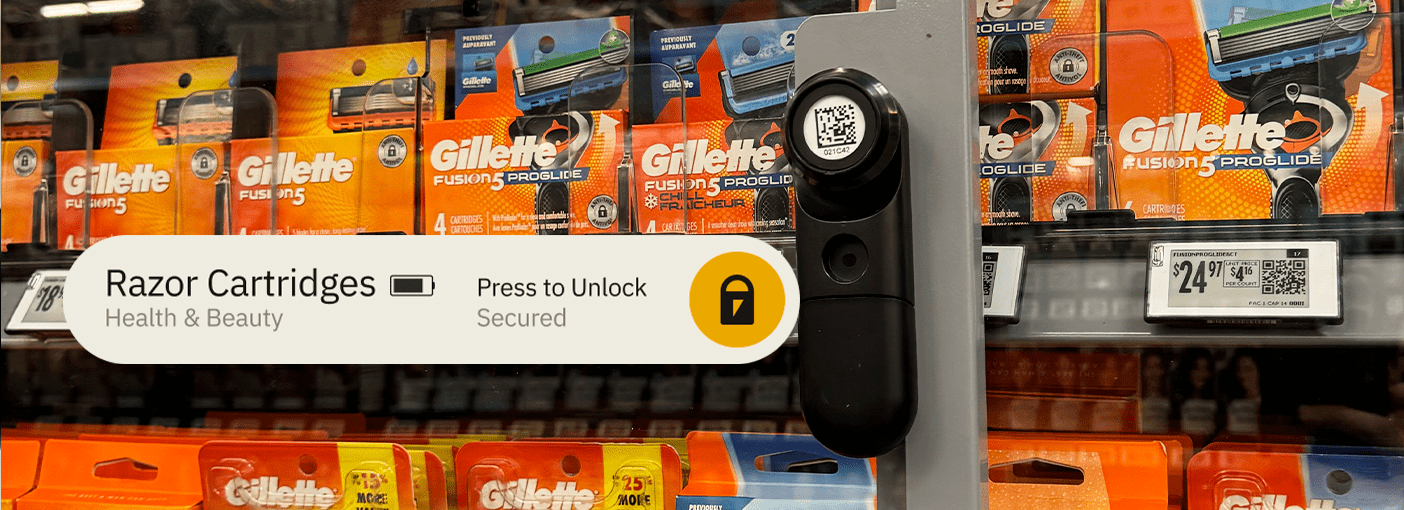
A customer drives to the store. They find the product. They’re ready to buy. Then friction gets in the way: a secured product they can’t immediately access, no associate in sight, a five-minute wait, and the sale doesn’t happen the way it should.
That customer hasn’t necessarily lost interest. When friction wins, the need rarely disappears. In 2024 AlixPartners’ 2024 Consumer Sentiment Index found that two-thirds of shoppers will leave a store or log off a site to buy an item elsewhere when they hit friction. The sale usually gets diverted, not eliminated.
The problem is still showing up today. Zebra’s most recent Global Shopper Study, surveying more than 4,200 shoppers and retail decision-makers, found that 52 percent of shoppers left a store without everything they intended to buy. Often because of access or availability issues rather than price.
Call it in-store cart abandonment. Retailers have tracked the online equivalent for two decades, carefully measuring when shoppers intend to buy but don’t complete the purchase. They’ve also spent years optimizing the friction that contributes to it, from unnecessary clicks to page-load speed.
But the physical version has received far less measurement. When a ready-to-buy customer needs help accessing a product, how long does it take to get that product into their hands? That “time-to-product” rarely exists as a formal retail KPI, even though it sits directly between purchase intent and conversion.
Even Amazon’s CEO has acknowledged the opportunity created by friction in the physical shopping experience. Andy Jassy told investors that shopping in a store where merchandise requires additional steps to access can be “a pretty tough experience.” His point wasn’t that retailers shouldn’t secure merchandise. It’s that when getting a protected product requires additional steps, shoppers may choose a more convenient alternative instead.
When the CEO of the world’s largest online retailer identifies friction in the physical shopping experience as an opportunity, it’s worth paying attention to.
When the customer needs help, the sale depends on what happens next
Requiring assistance doesn’t automatically mean losing a sale. In fact, Numerator’s 2024 research found that 62% of shoppers will typically wait for an associate to unlock a secured product. That’s an important distinction: secured merchandise doesn’t inherently stop the purchase. But it does create an access moment that the retailer needs to manage well. Other shoppers in the study said they would switch retailers, purchase online, choose an alternative, or abandon the purchase, showing how that additional step can change where, how, or whether the transaction is completed.
And access challenges aren’t limited to secured merchandise. A sale can be lost anytime a shopper can’t easily get to the product they came to buy, even when that product is technically available.IHL Group estimates retailers lose $1.2 trillion annually to inventory-related issues, including $165.6 billion attributed to customer service inadequacies and $145.2 billion to product-location failures. Those figures aren’t a measure of in-store cart abandonment or secured-merchandise friction, but they show how expensive the gap between having inventory and successfully connecting a customer to it can become.
For secured merchandise, access is one part of closing that gap. The product is available and the customer intends to buy it, but the retailer still needs to connect the two. When assistance is required, how that access moment is managed can influence whether the purchase reaches checkout.
Shrink Only Tells Half the Story
Other industries already recognize the cost of abandonment. Queue management systems measure a formally defined queue abandonment rate, and healthcare tracks patients who give up waiting as a Left Without Being Seen metric. Physical retail has a similar blind spot: a shopper can intend to buy a secured product, encounter difficulty accessing it, and leave without that moment ever appearing in a traditional shrink report.
Shrink, while essential, captures a different outcome. It tells retailers how much merchandise was lost, but not whether the measures used to protect that merchandise supported or complicated legitimate access. That distinction matters because a security strategy can perform well against shrink while still creating challenges elsewhere in the store.
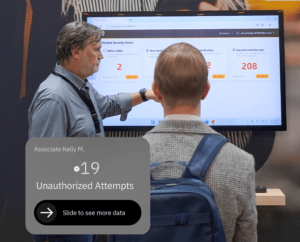
A more complete way to evaluate secured access is to consider protection, access, and accountability together. Protection asks whether unauthorized access is being prevented. Access asks whether authorized associates can get to merchandise efficiently when it is needed. Accountability asks whether the retailer has visibility into who accessed what and when. Together, those measures provide a broader view of how security is performing in day-to-day store operations, not just how much merchandise was lost.
The access piece is especially relevant to the customer experience. Numerator’s research found that 62 percent of shoppers will typically wait for an associate to unlock secured merchandise. The research doesn’t establish a universal threshold for how long shoppers will wait, but it does highlight an important operational reality: once a purchase requires assistance, the effectiveness of the access process becomes part of the path to purchase.
None of this means retailers should replace shrink as a measure of success or attempt to assign a precise value to every purchase that may have been abandoned. It means the definition of successful security can be broader: Did we protect the merchandise, make access work efficiently, and maintain visibility into that access?
That creates a more complete way to evaluate security, accounting for both the merchandise protected and the purchase journey around it.
Why this matters more as retail gets more automated
Self-checkout, mobile POS, app-based loyalty programs, all of it is designed to remove friction from the parts of the shopping trip a retailer controls directly. None of it helps if the product itself is the bottleneck. A customer who can breeze through a frictionless checkout process could still walk away twenty minutes earlier because nobody could unlock the case they needed fast enough.
As more of the store becomes self-directed, access becomes the one piece that still depends on a person, a key, or a system working exactly when the customer needs it to. Zebra’s research found that the share of shoppers blaming an unavailable associate for a failed purchase has grown over the past two years, not shrunk, even as retailers pour more investment into self-checkout and other self-service technology. That makes in-store cart abandonment more costly over time, not less, since every other point of friction in the store is getting solved around it while this one gets left behind.
Security Has to Work Across the Store
At scale, the question becomes bigger than any individual fixture. Different departments have different merchandise, theft risks, staffing models, and customer expectations. A security strategy has to accommodate that variation without creating a completely disconnected access process for every category.
The OneKEY Ecosystem is designed around that broader challenge, connecting access across different types of secured merchandise and access points while giving retailers greater control and visibility into authorized activity. That visibility can add operational value beyond the act of unlocking something. Coppel, for example, has seen the value from the data side. By analyzing access activity collected through OneKEY, the retailer gained greater visibility into store operations and reported improvements in efficiency, theft reduction, and sales.
The lesson isn’t that every retailer needs more technology or that every secured product needs to become more accessible. It’s that security should be designed around the behavior it needs to protect without losing sight of the behavior that creates the sale.
Retailers have spent decades studying how to get customers into stores, guide them toward products, and make checkout easier. Product access belongs in that conversation too. Once a customer has arrived, found what they want, and decided to buy, security should protect that opportunity without unnecessarily standing between purchase intent and the sale.
Matching the Fix to the Friction
Not every instance of in-store cart abandonment has the same root cause, so the fix shouldn’t be one-size-fits-all either.
| When merchandise needs to remain locked: | For high-risk products that require a secured fixture, the opportunity is to improve legitimate access without giving up the protection the fixture provides. Smart access control can reduce some of the dependency on traditional physical-key processes by moving toward managed access. OneKEY, for example, allows authorized associates to have individual, trackable access based on the permissions assigned to them. |
| Where retailers want to reduce associate dependency further: | Customer Self Access can extend controlled access directly to shoppers for selected merchandise, departments, or locations. The principle is the same in both cases: keep the product secured while reconsidering who can legitimately access it and how. |
| When security needs vary across the store: | The OneKEY Ecosystem supports different types of secured merchandise and access points across the store, allowing retailers to apply security according to the needs of the product and environment rather than forcing every category into the same approach. |
| When customers need to interact with a product before buying: For categories where interaction is part of the purchase decision, open-display and purpose-built security can keep products protected while preserving the experience customers need to evaluate them. | |
| For electronics and powered merchandise customers want to pick up, handle, and try while keeping products secured to the display. | |
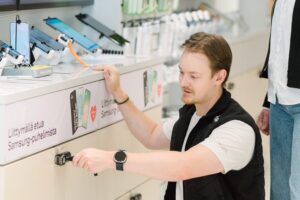
| For smartphones and electronics customers want to pick up, compare, and experience naturally at the display. | |
| For beauty and cosmetic testers customers need to see, touch, and try before deciding what to buy. |
| For luxury soft goods customers want to touch, inspect, and experience without compromising presentation. | |
| For laptops customers want to open, type on, compare, and experience while keeping devices and internal components protected. | |
| For soft goods such as handbags, apparel, and luggage that customers need to touch, inspect, or try without locking them away. | |
| For hanging products customers want to browse, pick up, and compare while keeping high-theft merchandise protected and accessible. | |
The goal isn’t more technology on the sales floor or less security protecting merchandise. It’s a security strategy built around how people actually shop and how stores actually operate.
Protect the product. Preserve legitimate access. And make sure a customer who arrives ready to buy has a clear path to doing exactly that.
Contact us today to get solutions that prevent shrinkage and increase sales.
Frequently Asked Questions: In-Store Cart Abandonment and Access Friction
What is in-store cart abandonment?
It’s the retail floor’s version of a shopping cart getting deserted mid-checkout: a customer who came in ready to buy hits friction at the point of access and leaves without completing the purchase. It isn’t about price or comparison shopping, it’s about a product being technically available but practically out of reach in that moment.
Can secured merchandise affect the customer experience?
It can when accessing a product becomes slow or difficult. Research shows that some shoppers will choose another retailer, buy online, select an alternative, or abandon a purchase when they encounter additional friction. The takeaway isn’t that retailers should leave high-risk merchandise unsecured. It’s that how customers access protected products matters. The right approach balances effective security with a fast, convenient path to purchase.
Does the customer’s need really disappear once they leave the store?
Rarely. Most shoppers who hit friction on something they intended to buy don’t give up on it, they take the purchase somewhere else, whether that’s a competitor’s store or a competitor’s website, a pattern AlixPartners’ 2024 Consumer Sentiment Index confirms at scale. The demand doesn’t vanish, it just moves to whichever retailer removes the friction first.
How can retailers identify in-store cart abandonment if it doesn’t show up in a shrink report?
There isn’t a single metric that captures in-store cart abandonment today, but connected access data can add another piece of the picture. InVue’s OneKEY Ecosystem gives retailers visibility into access activity across secured merchandise, helping them identify patterns in when and how products are being accessed. Paired with sales, traffic, and other store data, that visibility can help retailers better understand what is happening between product availability and purchase.
Does reducing in-store cart abandonment require less security?
No, it requires solving for speed and accountability together rather than trading one off against the other. The retailers doing this well aren’t running lighter security, they’re running smarter access, and Carrefour, and Coppel‘s own results back that up.

