
The 7 Daily Frustrations Retailers Have Accepted as “Normal”
A customer wants the headphones behind the glass. An associate goes looking for a key. Not the master (that one’s with the manager, who’s on lunch), so it’s the spare, which might be in the drawer at the front register, or maybe the office, or maybe whoever closed last night still has it in their jacket pocket.
Four minutes later, the customer has left to check the price on their phone. They found it cheaper somewhere else. Somewhere the case wasn’t locked.
Nobody wrote this into anyone’s job description. It just happened, one key at a time, until it became “how things work here.” That’s the trick with small frictions. They don’t feel like problems because nobody remembers deciding to accept them. They’re just Tuesday.
We pulled together seven of these moments. Read a few and you’ll probably recognize your own store in at least three of them.
1. “Why do we have so many keys?”
Walk the floor of a mid-size store and count the lock types: glass display cases, wood drawers under the counter, back-of-house storage, maybe a few older cabinets nobody remembers the vendor for. Each one tends to have its own key, its own cut, its own place it’s supposed to live (and rarely does).
New hires learn this the hard way: a week of “which key is this,” fumbling through a ring that looks like a janitor’s, while a customer waits. It’s not a training failure. It’s what happens when a store’s lock hardware got built up fixture by fixture over a decade instead of designed as one system. And once a key goes missing, which key it was and which drawer it opened tends to go with it.
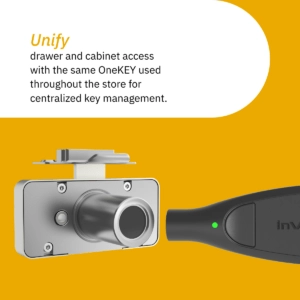
The fix isn’t a bigger key ring or a better labeling system. It’s removing the need for a ring at all. A single credential, one key or fob, that opens every fixture in the store, from the display case to the stockroom, is the whole premise behind InVue’s OneKEY ecosystem. The Self-Latching Drawer and Door Lock is part of that system, so a wood drawer under the jewelry counter and a locked glass case across the store open with the same credential.
When MediaMarkt made the switch, its stores went from a 10-key ring per associate to one. One key. Every fixture.
“Before we had a key ring with 10 keys and now, we only have one key for all showcases and the alarm system. That is ingenious.” – Baykan Sahin – Smartphone Department Manager, MediaMarkt.
2. “Who has the key?”
This one shows up as a customer standing at a locked case, waiting, while an associate radios around the store (“hey, do you have the case key?”) and gets silence, or a “check with Dana,” or nothing at all.
It’s not hypothetical. Numerator’s late-2024 shopper survey found 60% of consumers regularly run into locked-up merchandise, and 27% either abandon the purchase or walk to a competitor entirely rather than wait.
Every minute spent tracking down whoever has the key is a minute a shopper spends deciding whether this purchase is even worth the hassle. When every associate carries a credential that opens the case in front of them, that search disappears.
3. “Who opened this drawer?”
Shared keys create a strange kind of invisibility. When one key circulates through every shift, every associate, sometimes every manager who’s ever worked there, nobody can say with certainty who opened a given drawer at a given time. That’s not a trust problem. It’s a design problem: the hardware was never built to answer the question.
It matters more than it sounds like it should. InVue’s own breakdown of retail key management makes the same point about hypermarket back-of-house access: shared keys mean “there’s no record of who opened which cabinet when.” And the money at stake isn’t abstract. The National Retail Federation put total U.S. retail shrink at $112.1 billion in 2022, and internal theft, not shoplifting, accounted for roughly 29% of it. Appriss Retail’s 2026 Total Retail Loss Benchmark Report narrows that further: employee theft alone runs around $26 billion a year, and the firm estimates 73% of that shrink is preventable.
Preventable starts with visibility. Every OneKEY credential is tied to an individual, which means every open, whether it’s a case, a drawer, or a storage door, carries a name and a timestamp instead of a shrug. That’s the backbone of InVue’s access control approach: fewer shared codes, more accountability.

4. “Did I lock that drawer?”
A secured drawer might be opened dozens of times throughout the day as associates retrieve merchandise for customers. And every time it closes, there’s one more step to remember: lock it again. Miss that step once, and merchandise that was supposed to be protected could be left accessible until someone notices.
That same question can follow associates at the end of a long shift, too. Was every drawer relocked after the last customer? Is it worth walking back across the store to double-check?
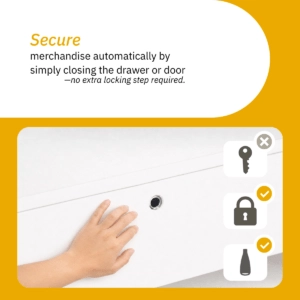
The Self-Latching Drawer and Door Lock removes that extra step altogether. Associates open it with OneKEY, and when the drawer closes, it automatically latches back into a secured state. There’s no separate relocking action to remember after every interaction.
It’s a small change to the workflow, but an important one: every close returns the drawer to a secured state, whether it’s the middle of a busy afternoon or 9:47 p.m. at the end of a long shift.
5. “Now we have to re-key everything.”
Somebody leaves. Doesn’t matter if it’s amicable or not, the standard procedure after turnover is to re-key whatever locks that person had access to, because you can’t un-cut a key that’s already out in the world.
Retail turnover runs around 60% industry-wide, according to BLS data, and hits 76% for part-time frontline staff, the group most likely to be handling keys on the floor. Re-keying isn’t a rare event at that rate; it’s closer to a monthly line item. InstaKey’s cost breakdown puts a single rekey (one lock, five redistributed keys) at roughly $263, and a chain running 1,000 locations at 20% turnover ends up spending around $52,600 a year just on rekeying doors. Grocery is its own case study: the average supermarket runs 17 doors on just 5 master keys, and losing a single one of those masters can cost about $1,068 to rekey. That’s before drawers, cases, and back-of-house storage even enter the math.
A OneKEY credential sidesteps the physical rekey entirely. When someone leaves, their access gets deactivated. No locksmith, no new cylinders, no waiting for a service visit before the store can trust its own locks again.
6. “This drawer used to close properly.”
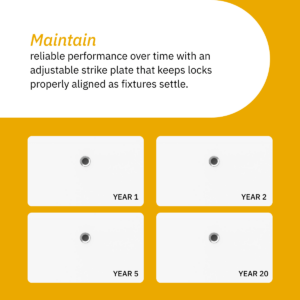
Wood moves. It swells in humidity, contracts when it’s dry, and after enough open-close cycles the hinges wear just enough that the latch stops lining up with the strike plate the way it did on day one. Nobody caused this. It’s just what happens to wood furniture that gets touched two hundred times a day.
The usual fix is a service call. Someone comes out, re-chisels the strike plate location or shims the hinge, and the drawer works again for another year or two. It’s a real cost, and it’s one nobody budgets for until the drawer’s already sagging. General commercial lock repair runs $50 to $250 a visit, according to locksmith pricing guides, and that’s before factoring in the appointment window and the drawer that sits out of service until someone shows up.
The Self-Latching Drawer and Door Lock pairs with an adjustable strike plate built for exactly this. When a fixture shifts over time, staff can realign the strike plate themselves and restore a secure fit, no reinstall required. No locksmith, no waiting on a technician’s schedule.
7. “Not another service call.”
Battery-powered electronic locks solve some of retail’s key problems and introduce a new one: batteries die, usually without warning, usually at the worst possible moment. Lock vendors who track this closely report standard battery packs in cabinet-style electronic locks dying every three to six months under typical daily use, turning a one-time install into a recurring line item nobody planned for. And every visit costs something: locksmith service call fees alone typically run $50 to $150, before any parts or labor.
A dead battery on a cabinet lock can leave retailers with two bad options: a locked case nobody can open or an unlocked case left vulnerable to theft while the issue is resolved. Either way, a maintenance problem has now become a security or customer-access problem.
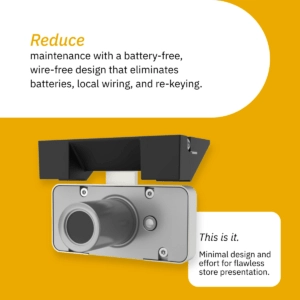
The Self-Latching Drawer and Door Lock doesn’t have this failure mode because it doesn’t have a battery. Power transfers from the OneKEY itself when it’s inserted. There’s no cell to replace, no charge to monitor, nothing sitting inside the lock waiting to die on a Saturday afternoon.
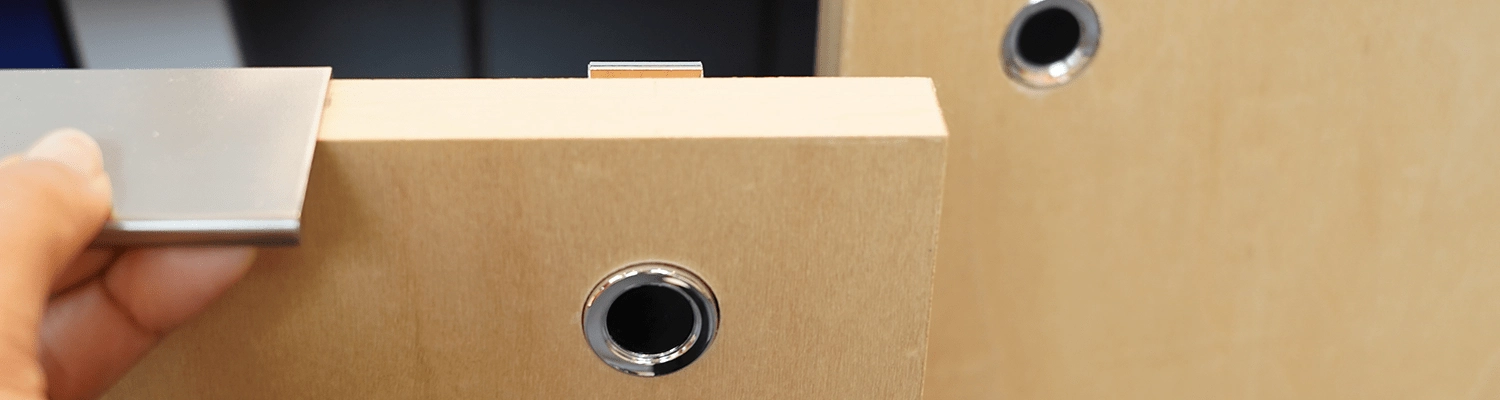
It also solves the installation fear that stops a lot of stores from upgrading in the first place: nobody wants to hear they need to replace every cabinet in the building. The Self-Latching Drawer and Door Lock is designed to embed into new or existing wood fixtures, with flexible mounting, adjustable screw holes, and short and long latch options that make it fit fixtures it wasn’t originally built for. Upgrading from an older 28mm lock is even less of a project than it sounds. A trim ring covers the existing opening so the fixture doesn’t need to be re-drilled or refinished. The lock just changes underneath, installed internally for a clean, semi-hidden look.
What this looks like once it’s actually running
None of this is theoretical. Bic Camera, a 41-plus store electronics chain in Japan, ran mechanical locks that had associates hunting down keys for every case sale, with wait times to match. After switching to OneKEY, the chain projected saving more than 1,370 hours of customer wait time. Sofmap, in the same market, had been losing close to 1,000 hours a year just to handling false alarms before making the same move.
“We’ve had almost zero false alarms, reduced customer wait time, and it allows store associates to focus on serving customers for a better shopping experience.” – Katsuyoshi Ishikawa, Managing Director, Bic Camera Inc.
That’s the pattern across most of these stories, documented across InVue’s case studies. It’s rarely one dramatic fix. It’s a dozen small frictions disappearing at once, and a staff that stops thinking about locks entirely.
None of this is actually “how retail works”
Every frustration on this list has the same root cause: mechanical, battery-dependent, one-off hardware that was never designed to work as a system. Retailers didn’t choose these problems. They inherited them, fixture by fixture, and adjusted until the adjustments felt normal.
The Self-Latching Drawer and Door Lock self-latching drawer and door lock is part of InVue’s OneKEY ecosystem, the same single-key approach that already runs display cases and storage doors across stores that have made the switch. It’s built specifically for wood doors and drawers, and it’s not a new idea being introduced to the market; it’s an improved version of hardware already doing this job, with a self-latching mechanism, no batteries, a compatible adjustable strike plate, and a design built to retrofit into fixtures already in place.
FAQ: Self-Latching Locks and Retail Key Management
No. It draws power from the OneKEY itself when it’s inserted, so there’s no battery to replace and no local wiring to install.
It’s built for wood doors and drawers. It retrofits into new or existing fixtures with adjustable mounting, adjustable screw holes, and short or long latch options.
Not completely. It’s installed internally for a clean, semi-hidden look that preserves the fixture’s appearance.
Their OneKEY credential gets deactivated. There’s no physical rekey, no locksmith, and no new cylinders required.
Yes. A trim ring covers the existing opening, so the upgrade doesn’t require re-drilling or refinishing.
Ready to Stop Thinking About Locks?
Every one of these frustrations is solvable with hardware built to work as a system instead of one fixture at a time. The Self-Latching Drawer and Door Lock is designed to be that system for drawers and doors.
Contact our team to talk through how the Self Latching Drawer & Door Lock works in your retail environment.

