
Self-Checkout Regulation Is Growing: What Retailers Need to Know
Self-checkout was designed to make retail faster, more convenient and more efficient. But as retailers balance customer experience with retail theft, shrink and labor demands, self-checkout is increasingly attracting the attention of policymakers.
And the conversation is no longer isolated to a handful of cities.
In September 2026, San Jose advanced a review of potential self-checkout safety and staffing standards for grocery and drug stores. Among the approaches under consideration are requirements around employee-to-kiosk ratios, transaction limits, staffed checkout availability and whether locked merchandise should be eligible for self-checkout.
The move follows self-checkout restrictions adopted or considered in other jurisdictions and comes as Rhode Island prepares to implement the nation’s first statewide self-checkout staffing ratio in January 2027.
For retailers, the trend raises a larger question:
How do you preserve the convenience of self-service while maintaining the control needed to protect merchandise, employees, and the customer experience?
Why Are Cities and States Regulating Self-Checkout?
Self-checkout is already a standard part of the retail experience across North America and is gaining traction in emerging markets around the world. As adoption grows, it gives shoppers more control over their journey while allowing retailers to rethink how labor is deployed across the store.
But the model can also create operational challenges.
Retailers must monitor multiple checkout stations, respond to exceptions, verify restricted transactions and address potential theft—all while trying to keep customers moving.
Those challenges are increasingly appearing in proposed retail regulations.
San Jose’s Rules and Open Government Committee advanced a review of potential self-checkout standards on September 16, 2026. The city is examining policies used or proposed in other jurisdictions, including approaches involving staffing, worker safety and oversight.
Potential requirements being discussed include:
- One employee monitoring no more than three self-checkout stations
- A 15-item limit for self-checkout transactions
- At least one staffed checkout lane remaining available
- Restrictions on purchasing locked merchandise through self-checkout
- Additional visibility and oversight requirements
The San Jose proposal remains under review and has not become law.
Rhode Island has gone further. Beginning January 1, 2027, grocery stores offering self-checkout will be required to maintain at least one staffed checkout for every three self-checkout stations in operation. Employees assigned to monitor self-checkout must also be relieved of other duties while performing that role.
Taken together, these developments point to a broader shift: the operational design of self-checkout is becoming a policy issue, not simply a technology decision.
Locked Merchandise Creates Another Challenge
The conversation becomes even more complicated when merchandise is secured.
Traditional locked cases can protect high-value or high-theft products, but they often introduce another dependency into the shopping journey: finding an employee. A customer may be perfectly capable of navigating a store and completing a self-checkout transaction independently, yet still need an associate simply to access the product they want to purchase. If regulations further restrict how locked merchandise can move through self-checkout, retailers could face even more friction between merchandise protection and self-service.
That makes the question bigger than whether a retailer should lock a product.
How can retailers control access without unnecessarily interrupting the customer journey?
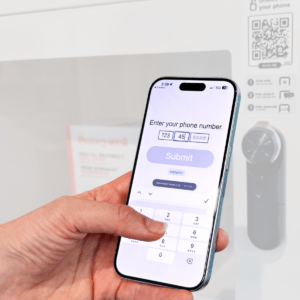
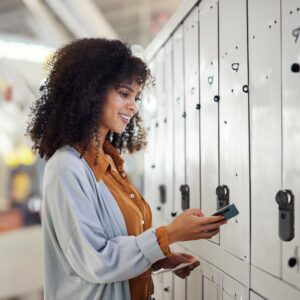
One approach is Customer Self-Access, which allows retailers to give verified customers access to secured merchandise without requiring an associate to unlock the fixture. Retailers maintain control over who can access merchandise, while access events remain traceable and governed by retailer-defined security policies.
The Next Generation of Retail Security Is About Controlled Access
Historically, merchandise security has often relied on a binary approach: a product is either accessible or locked.
Smart access creates another option.
With connected solutions such as OneKEY and smart locks, retailers can create authenticated interactions with secured merchandise while gaining greater visibility into access activity.
Instead of treating every unlock as an anonymous exception requiring an employee response, retailers can create a more controlled process around who accessed merchandise, when access occurred and where it happened.
That changes the role of retail security.
Security is no longer only about creating a physical barrier between a shopper and a product. It can also be about creating controlled access with greater visibility and accountability.
Controlled Access Can Support a More Flexible Store
No technology can guarantee regulatory compliance, and requirements will vary by jurisdiction. But the operational problems driving many of today’s self-checkout proposals should matter to every retailer.
Retailers are being asked to provide greater oversight without sacrificing the convenience shoppers increasingly expect.
Smart access can be part of that strategy.
Controlled access → fewer unnecessary exceptions → greater oversight → more checkout flexibility
Solutions like Customer Self-Access can help reduce routine associate unlock requests by enabling verified shoppers to access merchandise themselves. Meanwhile, the OneKEY ecosystem gives retailers a connected approach to managing access across associates, customers, devices and secured fixtures.
For customers, that can mean less waiting. For associates, it can mean fewer routine unlock requests. For asset protection teams, it can mean greater visibility into access activity. And for retail operations teams, it can provide more options for designing stores around both security and convenience.
Retail Security and Self-Checkout Can No Longer Be Separate Strategies
Self-checkout, merchandise protection and labor have traditionally been treated as separate operational decisions.
Increasingly, they are connected.
A security decision that creates too many employee interventions can affect labor. A labor constraint can affect self-checkout. A poorly controlled self-checkout environment can increase scrutiny from policymakers. And new restrictions can ultimately affect the customer experience. Retailers therefore need to think beyond individual devices and consider the entire journey:
How does a shopper access a product, move through the store and complete the transaction—with the right level of control at every step?
That’s where connected retail security and smart access become increasingly important. The goal isn’t simply to lock merchandise. It’s to give retailers greater control over access while keeping the shopping experience moving.
Explore how InVue Customer Self-Access can help retailers create secure, self-service access to merchandise.

