
Cost of Entry: A Guide to Anti-Theft Devices for Mobile Phones and Tablets
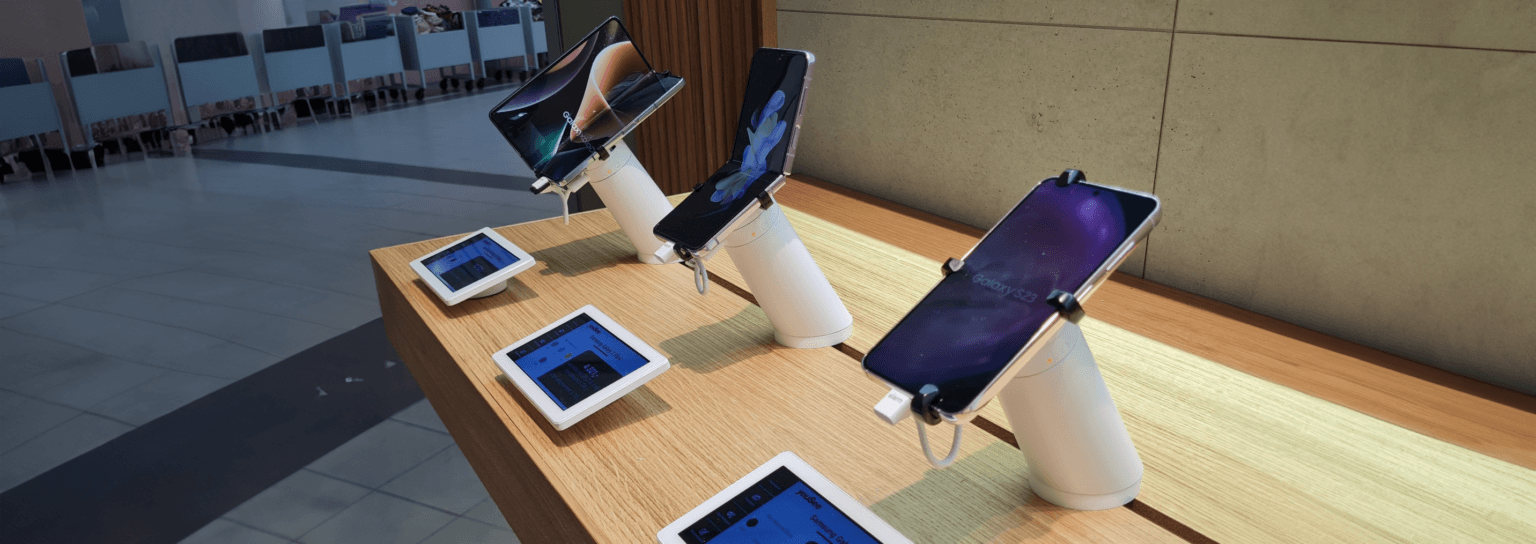
The average US retail price of an iPhone hit a record $1,018 in 2024, according to Consumer Intelligence Research Partners. The same pressure applies across merchandise categories far beyond mobile. Power tools, fragrances, cosmetics, and health and beauty products face comparable theft exposure in home improvement, specialty retail, and grocery environments and the cost of getting the security decision wrong is just as high regardless of category. That’s before you factor in tablets, wearables, and the rest of the high-value merchandise sitting on your display floor every day.
Most retailers treat anti-theft device selection as a procurement decision. Find something that physically attaches to the product, check the price, place the order. The problem with that approach is that the wrong device doesn’t just fail to stop theft. It stops the purchase. A device that creates friction between the customer and the product changes what happens on the floor before a buying decision is made.
A security solution that requires associate intervention before a customer can hold a product, limits how far a device can travel on a tether, or adds visible bulk to a premium display changes what happens on the store floor before a purchase decision is made. That cost doesn’t show up in the shrink report. It shows up in conversion rates and the number of customers who walk out without buying anything.
Choosing the right retail anti-theft device means understanding your merchandise, your customers, and your store before you evaluate any product. These eight factors are where that process starts.
8 Factors to Consider When Choosing Anti-Theft Devices for Electronics Store Displays
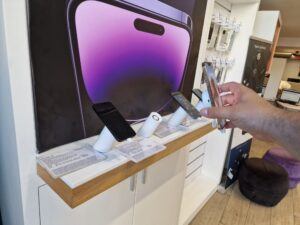
Of course, you want anti-theft devices to protect your inventory, but there’s more features to consider than just protection. Can customers freely interact with merchandise on display, or do they require a store associate for access? It’s important that they don’t just reduce theft but enhance the shopping experience.
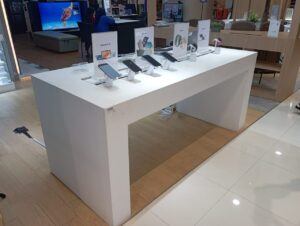
Consider the type of merchandise you need to safeguard, and then evaluate the space and layout of your retail store. Select an anti-theft device that seamlessly integrates with your store’s design and meets its specific security needs.
 |  |
Here are additional things to consider and questions to ask before making your decision.
The device has to match the product, and not just physically. It has to match the theft vector.
A smartphone on a display stand gets stolen differently than a blister-packed accessory on a peg hook. A soft goods item like a handbag has a completely different vulnerability profile than a boxed electronic. Each merchandise category attracts different theft behavior, from opportunistic grab-and-run to organized sweep methods to magnet-based tag defeat, and the security device has to address the actual method, not just attach to the product.
Start here. If you’re selecting a device before you’ve mapped it to the specific theft risk for that merchandise category, you’re guessing.
This is the factor most buyers underweight, and it’s the one with the highest downstream cost when it’s ignored.
Customers who can’t pick up a phone and hold it, try on a watch, or engage with a product the way they naturally would don’t commit to buying it at the same rate as customers who can. That’s not a preference. It’s a documented behavioral pattern in retail. Security that restricts interaction restricts sales.
The question to ask before selecting any device: what does a customer need to do with this product before they’ll decide to buy it? The retail display security solution has to preserve that interaction completely, or you’re trading shrink reduction for conversion loss. In most merchandise categories, that’s not a trade worth making.
Wall fixtures, countertops, slatwall, pegboard, gondola ends, and freestanding pedestals all present different mounting requirements. A security device that works on one fixture type and creates problems on another forces you into a patchwork program that’s expensive to manage and inconsistent to enforce.
Retrofitting capability matters here. Stores don’t get redesigned every time a security decision changes. The device you choose needs to integrate with what’s already on the floor, not require a fixture replacement or a construction project to go with it.
Security hardware that dominates a display is security hardware that competes with the product for the customer’s attention. In premium retail environments, that’s a visual merchandising problem as much as a security one.
Low-profile design isn’t aesthetics for its own sake. It’s a requirement. The security device should be noticeable enough to deter theft, enhance the presentation of the product, and invisible enough to let the product sell itself. Those two requirements aren’t in conflict if you’re selecting the right solution for the environment.
The answer to this question changes the solution more than almost any other factor.
Securing a handful of high-value displays is a different problem than managing security across every fixture type in a 50,000 square foot store. At scale, device consistency determines whether your security program is manageable. Multiple key types, multiple alarm protocols, and multiple device management systems running simultaneously create operational overhead that compounds directly into associate time and your loss prevention team’s ability to monitor what’s happening across every corner of the store. It also makes remerchandising and planogram changes harder than they need to be.
If you’re thinking at the store level rather than the display level, the system those devices connect to matters as much as the devices themselves. The OneKEY ecosystem is built specifically for this: one key, every fixture, every aisle.
Complexity is a hidden cost that most device evaluations don’t account for.
If unlocking a display requires an associate to find the right key, complete a multi-step process, and then manually re-secure everything after the customer interaction, two things happen. Associates start avoiding the process where they can. Customers notice the delay and lose patience. Neither outcome serves the store.
Ease of use for both parties isn’t a convenience feature. It’s a performance requirement. The best retail store anti-theft device is one that does its job without either side noticing the friction.
Product dimensions change constantly across every merchandise category. Phone screen sizes shift every generation. Power tool form factors evolve. Fragrance bottle shapes vary across brands and product lines. New form factors appear. Retailers who buy security devices sized precisely for this year’s flagship model often find themselves replacing hardware when next year’s lineup doesn’t fit the same bracket.
Universal mounting capability and tool-free remerchandising reduce that cost significantly. A device that can adjust to accommodate different sizes, formats, and orientations without requiring new hardware is a device that stays useful beyond the current product generation.
Price per unit is the wrong number to anchor on.
The real cost of a retail anti-theft device includes associate time spent managing, unlocking, and re-securing it across every interaction. It includes rekeying or replacement costs when devices are defeated or go missing. It includes the conversion loss from customer friction. And it includes the operational overhead of managing incompatible systems across a store floor.
A device that costs less per unit but slows associate service, creates accountability gaps, or can be defeated by a basic tool available at any hardware store costs more than it saves. Total cost of ownership is the right calculation. Price per unit is just the starting point.
Matching the Right Anti-Theft Device to Your Merchandise
The eight factors above tell you how to evaluate. This section tells you what that evaluation typically produces for each major merchandise category in retail display security.
This is the category where customer experience and loss prevention objectives are most directly in tension with each other. Customers need to hold the device, explore its features, and try it on before they’ll commit. A security solution that restricts any of that is a solution that costs the store sales.
OnePOD Max isengineered to blend premium customer experience with robust security for phones, tablets, and wearables. Intelligent, modular brackets automatically adjust to fit each device’s unique shape and size, then close securely when a device is detected, with no extra steps required. For store associates, access is effortless. OnePOD Max integrates with OneKEY and the OneKEY app, enabling fast, secure unlocking via NFC, Bluetooth, or 2D barcode scan. Remerchandising is completed in under a minute, with zero tools needed. Built with reinforced steel, OnePOD Max delivers powerful protection without disruptive external alarms, preserving a clean, uninterrupted shopping experience.
It also connects directly to the OneKEY ecosystem, so every access event is tracked and every user is accountable.
This is the category where the most common security assumption is also the most dangerous one.
Standard EAS tags on soft goods merchandise are vulnerable to magnet defeat. The magnets required to remove them are inexpensive and widely available. Retailers who rely on standard soft goods tags often don’t discover this vulnerability until after a loss pattern has already established itself.
For standard soft goods and apparel, Cable Lock is the only soft goods security cable lock that cannot be defeated by magnets. That distinction matters operationally because it closes a theft vector that most standard solutions leave open. It’s designed specifically for high-value soft goods and provides best-in-class protection with an alarming lanyard lock that works the way the category actually needs it to.
For premium and luxury retail environments where presentation is as critical as protection, Luxe Lock is designed to resolve the tension between security and aesthetics. It safeguards high-value pieces with discreet, intelligent security that preserves the beauty of every item on display. Dyneema tethers protect fine leathers and delicate finishes without marking or distorting them. It withstands up to 350 lbs of pull force while remaining completely tool-free for associates to reposition and remerchandise. A refined cover slides over the mounting plate whenever a Luxe Lock isn’t in use, keeping the display clean and uninterrupted. Like all InVue solutions, it operates within the OneKEY ecosystem, every access event is logged automatically.
If you’re securing apparel, accessories, or other soft goods and your current solution uses standard EAS tags, that’s worth a direct conversation with your LP team about what you’re actually protected against.
The challenge with packaged goods is visibility without access. Customers need to see the product clearly. They don’t need to open the packaging before purchase. And the merchandise needs to stay exactly where it’s placed on the display.
InVue offers two solutions for this category depending on the merchandise type and display format.
Package Wrap is the industry standard for high-theft boxed merchandise protection. It’s the only wrap solution on the market that cannot be defeated by magnets, a meaningful distinction given how common magnet-based defeat has become across retail categories. Expandable cables accommodate a wide range of small to large-sized merchandise. The low-profile design maintains maximum visibility of package graphics and product information. A ratcheting mechanism ensures a tight, secure fit. And like all InVue solutions, Package Wrap operates within the OneKEY ecosystem, one key to remove it at the point of sale, every access event logged.
Safers protect merchandise in fully enclosed transparent polycarbonate housing, so customers have complete visibility of the product without the ability to access it before the point of sale. They’re secured by OneKEY, reusable, and effective across a wide range of packaged merchandise categories including electronics accessories, health and beauty products, and specialty retail goods.
Package Wrap is the right choice when product visibility of the packaging itself matters, customers can read the graphics, see the product details, and make the purchase decision from the shelf. Safers are the right choice when full enclosure is the requirement and product dimensions fit the housing.
The primary theft method for hanging merchandise on peg hooks, slatwall, and gridwall isn’t sophisticated. It’s fast. An organized retail theft crew can clear a peg of batteries, blades, or accessories in seconds. Standard open hooks provide no resistance to that method at all.
T1000 addresses sweep theft with a self-service, time-delay dispensing mechanism. Products are dispensed one at a time with a built-in delay that slows removal enough to deter organized theft while keeping merchandise fully accessible to legitimate customers. It’s economical, compatible with existing peg fixtures, and doesn’t require a fixture replacement or associate involvement for every customer interaction. The time-delay mechanism is what makes it work operationally. It doesn’t stop a customer from getting the product. It stops the speed that organized theft depends on.
For retailers who want hanging merchandise protection within the OneKEY ecosystem, InVue’s Locking Hook secures individual peg hook positions with OneKEY access. Associates unlock specific hooks when needed, and every access event is logged, giving LP teams visibility into which hooks are being accessed, when, and by whom.
Why the System Matters as Much as the Device
A store that secures phones with one system, soft goods with another, packaged merchandise with a third, and hanging merchandise with a fourth isn’t running a security program. It’s running four separate security programs simultaneously, with different keys, different alarm types, different management interfaces, and no centralized visibility into what’s happening across the floor.
That complexity has a direct operational cost. Associates manage it poorly because it’s confusing to manage well. LP teams can’t see patterns across device types. And when something goes wrong, there’s no unified audit trail to investigate from.
The OneKEY ecosystem connects display security devices and access credentials into one system. One key opens every secured display in the store. Every access event is logged with a complete record of who accessed what, when, and where. If a key is lost or stolen, it’s deactivated immediately with no rekeying required. And the system scales across fixture types, merchandise categories, and store locations without adding management layers.
The device-level decision and the system-level decision aren’t separate. The security solution on each product only works as well as the system connecting all of them. When those two things aren’t aligned, scale breaks the program.

Frequently Asked Questions
EAS tags are electronic article surveillance devices that trigger an alarm when they pass through sensors at store exits. They’re primarily an exit-detection system rather than a point-of-interaction deterrent. InVue’s Cable Lock is a soft goods security solution with an alarming lanyard lock that secures the merchandise itself, triggering an alarm on unauthorized removal at the product level rather than waiting for an exit detection event. The two serve different purposes and many retailers use both. The important distinction for soft goods is that standard EAS tags are vulnerable to magnet defeat, while purpose-built cable locks like InVue’s Cable Lock are specifically designed to be magnet-resistant.
Standard EAS solutions for soft goods are vulnerable to removal with inexpensive magnets. For genuine protection, you need a solution designed specifically for this vulnerability. For soft goods and apparel, InVue’s Cable Lock is the only soft goods security cable lock that cannot be defeated by magnets, making it the more reliable option for apparel, accessories, and other soft goods categories where magnet-based theft is a documented risk. For luxury and premium merchandise where presentation is as important as protection, Luxe Lock combines magnet-defeat-proof OneKEY security with a refined, low-profile design that preserves the aesthetics of high-value displays. Both solutions operate within the OneKEY ecosystem.
Start with the interaction requirement. Ask what a customer needs to do with the product before they’ll commit to buying it. The security device has to preserve that interaction completely. For phones and tablets, that means full hands-on access without associate intervention. For wearables, that means try-on capability. For packaged goods, that means full product visibility. Any device that adds steps between the customer and the product they’re evaluating is a device that costs you conversions. Browse merchandise display security solutions to see options built around this principle.
Yes, especially if the underlying access system connects them. Using incompatible devices across different merchandise categories creates a management problem at scale: multiple key types, multiple alarm protocols, and no centralized visibility. InVue’s OneKEY ecosystem is designed to connect display security across every merchandise category and fixture type in the store so associates use one key and LP teams see one audit trail.
Four things: full hands-on access for customers without associate intervention, automatic locking when a device is detected, fast remerchandising capability when products change, and connectivity to a storewide access system. A device that checks the first three but operates in isolation from the rest of your store security creates a management gap. OnePOD Max is designed to satisfy all four requirements for phones, tablets, and wearables in any form factor.
The right anti-theft device for your store depends on what you’re selling, how your customers shop, and what your floor needs to do every day. InVue’s team works with retailers across every merchandise category to match the right solution to the right situation.
Explore Merchandise Display Security

